
Ten orders. Nine come back.
That’s not a hypothetical. That’s the reality Arthur Feenstra, CEO of OFM, described in a recent podcast episode and it’s a pattern that will sound familiar to anyone running a fashion brand online.
Returns have always been part of ecommerce. But in fashion, they’ve become something else entirely: one of the biggest drains on profitability, one of the hardest operational problems to solve, and one of the most stubborn obstacles between a good product and a healthy business.
So why is the fashion return rate so high and what’s actually working to bring it down?
The root cause isn’t the product. It’s the decision.
Most returns in fashion aren’t caused by poor quality or misleading photos. They’re caused by uncertainty at the moment of purchase.
A shopper finds a jacket they love. They’re not sure if they’re a medium or a large. They order both. One goes back.
This happens millions of times a day across the industry. And for years, the standard response was to either accept it as a cost of doing business, or to try to discourage returns through fees and policy changes, neither of which actually solves the problem.
The real issue is that online shopping removed the fitting room. Shoppers used to be able to try before they bought. Now they can’t. And in the absence of that certainty, they hedge. They over-order. They return.
The question isn’t how to make returns harder. It’s how to make the right decision easier.
Why the obvious solutions haven’t worked
Size charts have been around forever. Most shoppers ignore them and the ones who do use them still find them inconsistent across brands and garments.
Product reviews help, but only when they’re plentiful, recent, and from people with similar body types.
“Model is 180cm and wearing a size M” is useful context, but it still requires the shopper to do mental math on their own body.
None of these solutions address the core problem: the shopper doesn’t know how this specific garment will fit their specific body.
What retail intelligence actually does differently
Retail intelligence tools that combine shopper data, garment data, and machine learning approaches the problem from a different angle.
Instead of giving shoppers more information to interpret, it gives them a direct answer.
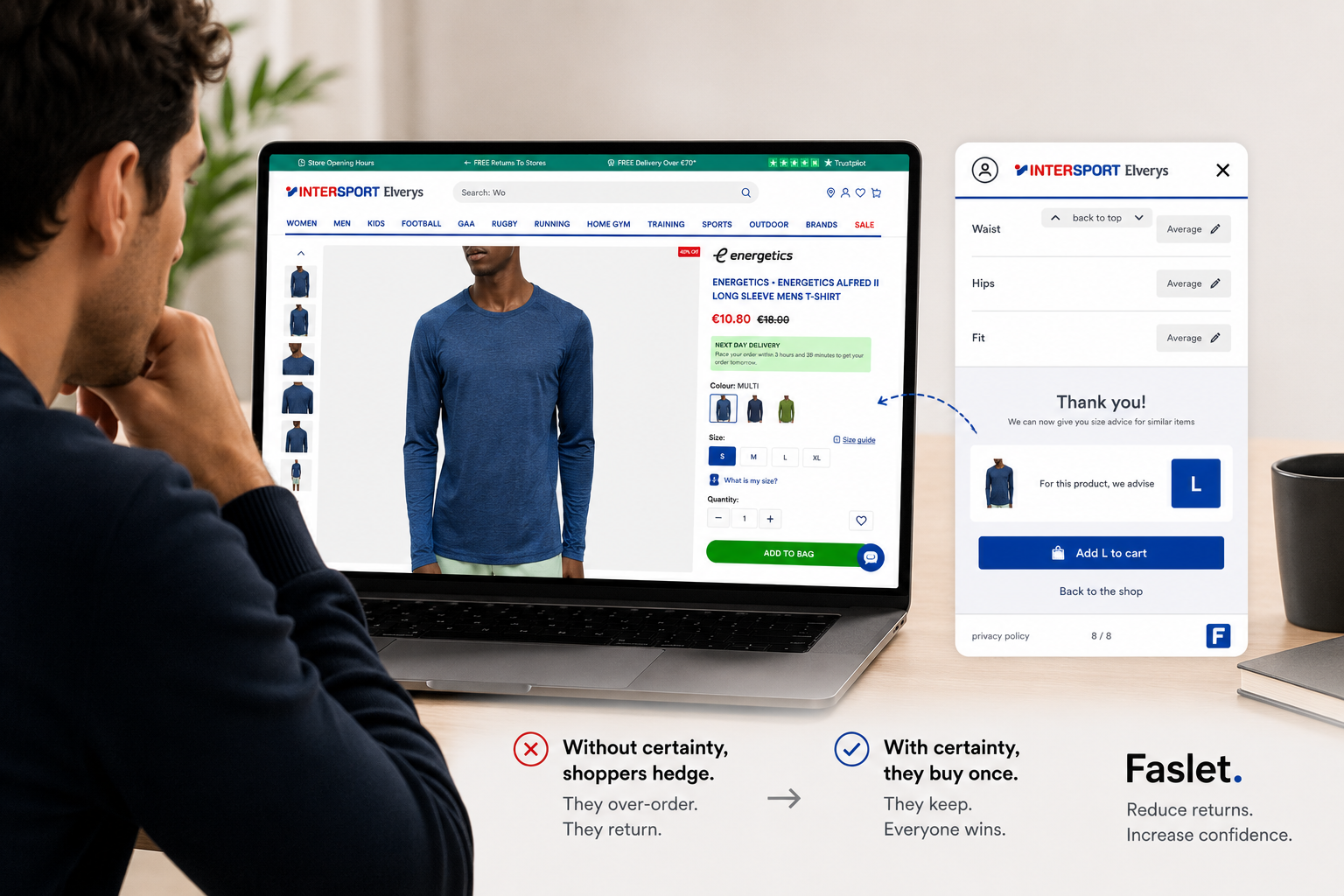
When a shopper opens a size recommendation tool on a product page, they answer a few simple questions: height, weight, how they prefer their clothes to fit. The system cross-references that with data from thousands of previous orders and returns for that specific garment, and tells them: your size is M.
Not a range. Not a suggestion. A recommendation they can trust.
The difference in shopper behaviour is significant. Someone who receives a confident, personalised size recommendation is far more likely to order one size and keep it because the uncertainty that drove the hedge-buying is gone.
The OFM example: from a third to 25%
OFM is a Dutch menswear retailer with 25 stores and €70–75 million in annual revenue. They’ve been in the business for 24 years. When their CEO talks about returns, he’s speaking from deep experience.
In a recent episode of the Doorzetters Podcast, Arthur Feenstra put it plainly:
“Returns are the biggest drama in fashion retail. Fortunately, through systems like Faslet and other partners that advise better we’ve brought our return rate down from a third to 25%. That’s great.”
A reduction from roughly 33% to 25% might sound incremental. At OFM’s scale, it represents thousands of avoided returns every month – lower logistics costs, less pressure on warehouse operations, and meaningfully better margins.
Critically, this wasn’t achieved by restricting returns or adding friction to the buying process. Conversion didn’t suffer. Shoppers simply made better decisions because they had better information.
The broader shift: from accepting returns to preventing them
What’s changing in the industry isn’t just the technology, it’s the mindset.
For a long time, high return rates were treated as a fixed cost: something to be managed, not solved. The conversation was about reverse logistics, restocking efficiency, and return windows.
That conversation is shifting. The brands seeing the most meaningful results aren’t optimising the returns process, they’re reducing the number of returns that happen in the first place, by investing in the moment that matters most: the purchase decision.
Retail intelligence sits at that moment. It doesn’t ask shoppers to do more work. It doesn’t require a policy change. It integrates quietly into the product page and gives shoppers the one thing they actually need: confidence.
What this means for fashion brands
If your return rate is above 20% and in fashion, many brands are significantly higher, the question worth asking isn’t how to handle returns better. It’s what’s causing them.
In most cases, the answer is uncertainty. And uncertainty is solvable.
The tools exist. The data shows they work. And the brands that are moving on this now are building a compounding advantage: better margins, better shopper experiences, and more data to make future recommendations even more accurate.
Returns will never be zero. But a third of your orders coming back? That’s not inevitable.
It’s fixable.
Faslet helps fashion and footwear brands reduce returns through personalised size advice directly on the product page. Want to see what it could look like for your store? Book a demo.